The Impact of Gummy Mould Shapes on Depositing Speed and Rejection Rates
The Impact of Gummy Mould Shapes on Depositing Speed and Rejection Rates
When a brand founder envisions a new gummy supplement, they often focus heavily on the visual aesthetic. They might request a gummy shaped like a detailed cannabis leaf for a CBD product, a complex geometric brain for a nootropic, or an intricate logo with sharp, embossed lettering.
The contract manufacturer looks at the CAD drawing of the mould and sighs.
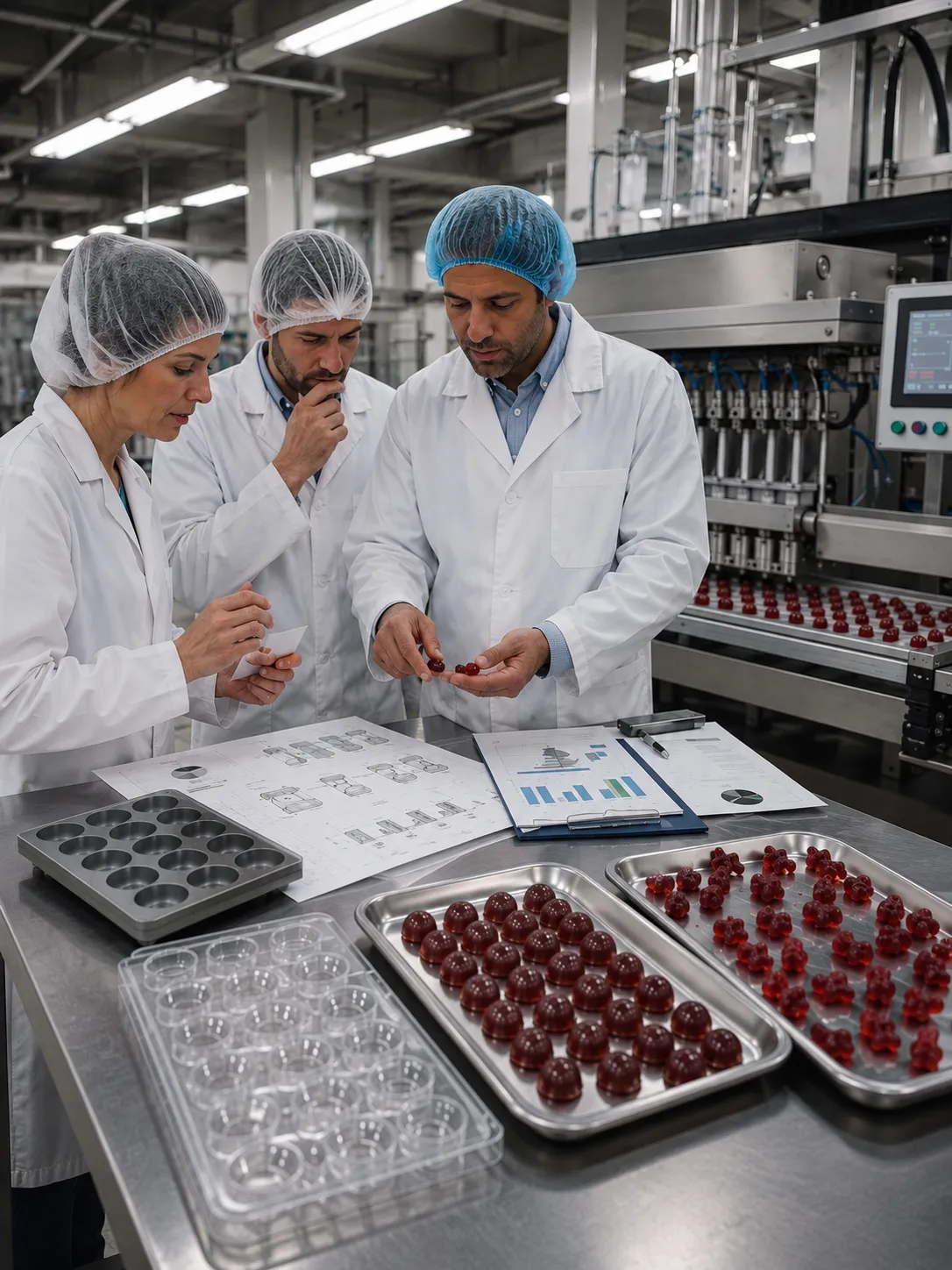
While custom shapes are excellent for marketing and brand differentiation, they are a nightmare for physics. The shape of a gummy mould directly dictates the depositing speed, the curing time, and - most importantly - the rejection rate of the finished product.
If you design a beautiful gummy that the manufacturing line physically cannot eject cleanly, your rejection rate will skyrocket from a standard 2% to a catastrophic 20%. The manufacturer will pass those losses directly onto you via higher unit costs.
Before you finalize your brand guidelines, here is the technical reality of how gummy mould shapes impact manufacturing efficiency and why "simple" is almost always more profitable.
1. The Physics of Depositing: Viscosity and Flow
Functional gummies are not poured like water; they are deposited as a highly viscous, sticky syrup (often resembling hot honey).
In modern starchless depositing lines, a servo-driven pump forces this hot pectin or gelatin syrup through a nozzle into a silicone or Teflon-coated metal mould.
The Problem with Intricate Details
If a mould has sharp corners, deep crevices, or tiny details (like the fingers of a hand or the serrated edges of a leaf), the highly viscous syrup struggles to flow into those microscopic spaces before it begins to cool and set.
- The Result: The gummy will have "voids" - air bubbles trapped in the corners, leading to incomplete or deformed shapes.
- The Fix: The manufacturer must slow down the depositing speed significantly to allow the syrup time to flow into the details. Slowing down the line reduces the daily output, increasing the manufacturing cost.
The Advantage of the Dome
The most efficient shape in gummy manufacturing is the standard "Dome" or "Gumdrop." The smooth, continuous curve allows the liquid to flow instantly and perfectly fill the cavity. Air bubbles naturally slide up the curved edges and escape. Depositing speeds can be maximized, running hundreds of thousands of units per hour with near-zero deformation.
2. The Demoulding Crisis: Tearing and Sticking
After the gummy sets in the cooling tunnel, it must be physically popped out of the mould. This is where intricate shapes cause the most financial damage.
The "Undercut" Danger
An undercut is any part of a mould where the bottom is wider than the top, or where there are sharp indentations. When the machine attempts to push the gummy out of a silicone mould, an undercut acts like an anchor. Instead of popping out cleanly, the gummy tears. A torn gummy is a rejected gummy. If a complex mould causes 15% of the gummies to tear during ejection, the brand is paying for 15% wasted raw materials.
The Pectin Disadvantage
Gelatin is highly elastic; it can stretch and deform slightly as it is pulled from a mould, allowing it to survive more complex shapes (which is why classic gummy bears have so much detail). Pectin is not elastic. Pectin has a "short" bite, meaning it breaks cleanly rather than stretching. If you use a complex mould with sharp edges for a vegan pectin gummy, the edges will snap off during demoulding.
For premium pectin gummies, manufacturers mandate smooth, geometric shapes - cubes, domes, or simple spheres - to guarantee a clean release.
Learn about Vegan & Pectin Gummies
3. Curing and Surface Area
Once the gummies are demoulded, they move to a climate-controlled curing room to dry and reach their target water activity ($a_w$).
The Moisture Migration Issue
The speed at which a gummy cures depends heavily on its surface-area-to-volume ratio.
- A flat, thin gummy (like a coin) has a massive surface area relative to its volume. It will dry out very quickly.
- A thick, cubic gummy has a lower surface area and will take significantly longer to cure in the center.
If a brand requests a highly unusual shape with both thick and thin sections, the thin sections will dry out and crystallize, becoming hard and brittle, while the thick center remains too soft. Achieving an even, consistent cure requires a uniform shape.
Explore Functional Gummy Manufacturing
4. Packaging Automation and "Bridging"
The shape of the gummy affects the final stage of manufacturing: bottling.
High-speed bottling lines use multi-head weighers that drop a precise amount of gummies through a funnel into the bottle.
- If the gummies are shaped like interlocking puzzle pieces, stars with sharp points, or long cylinders, they will "bridge" - locking together and jamming the funnel.
- The line must be stopped, and an operator must physically clear the jam. Every minute the line is down costs money.
- Smooth domes or cubes flow like water through the packaging machinery, ensuring maximum efficiency and lower packaging costs.
5. The True Cost of Custom Tooling
If you insist on a custom shape (e.g., your company logo), you must pay for "Tooling."
A modern starchless depositing line requires thousands of individual silicone or metal moulds to operate at scale. To create a custom shape, the manufacturer must commission a specialized engineering firm to mill these custom moulds.
- The Cost: Custom tooling can range from $15,000 to $40,000 depending on the size of the line.
- The Time: Designing, testing, and manufacturing the custom moulds can add 8 to 12 weeks to your product launch timeline.
- The Risk: If the shape proves too difficult to demould during the pilot run, the expensive tooling must be scrapped and redesigned.
For 95% of brands, the ROI of a custom shape does not justify the tooling cost, the delayed launch, or the higher rejection rates. Utilizing the manufacturer's "stock" shapes (like a premium 3-gram dome) is a vastly superior commercial strategy.
Explore Export-Ready Manufacturing
FAQ
Can I get a custom colour instead of a custom shape? Absolutely. This is the smartest way to differentiate your product. A manufacturer can easily customize the colour profile using natural plant extracts (like Spirulina for blue/green or Black Carrot for deep red) without affecting the physics of the mould or incurring tooling costs.
Are gelatin gummies better for complex shapes? Yes, because gelatin is elastic, it survives the demoulding process much better than pectin. If your brand identity absolutely requires a highly detailed, 3D character shape, you may have to sacrifice the "vegan" positioning and use gelatin.
What is the ideal weight for a gummy? The commercial "sweet spot" for functional gummies is 2.5 grams to 3.5 grams. This size is large enough to hold a meaningful active payload (like 100mg of Vitamin C or 200mg of botanical extract) but small enough to cure evenly and fit easily into standard retail bottles.
Optimize for Manufacturing Efficiency
A successful supplement brand is built on margins, not just marketing. Designing a product that is optimized for manufacturing efficiency ensures lower unit costs, faster lead times, and fewer failed batches.
At Probiota Innovations, our engineering team works directly with brands to select optimal mould shapes that guarantee high-speed depositing and flawless demoulding. We specialize in precision-engineered, smooth-profile pectin gummies that deliver premium aesthetics and zero tearing, ensuring maximum profitability for your commercial run.
Request a Project Brief Explore Functional Gummy Manufacturing
Want to discuss your formulation?
Our experts help brands launch technically complex probiotic and functional gummies.